
The Little Picture House

One scientist believes an airliner is running out of time. Convincing everyone else may be his greatest challenge.
1951 · Aviation drama / Suspense · United Kingdom / United States · English · Black and white · Approximately 99 minutes
Also released as No Highway.
Synopsis
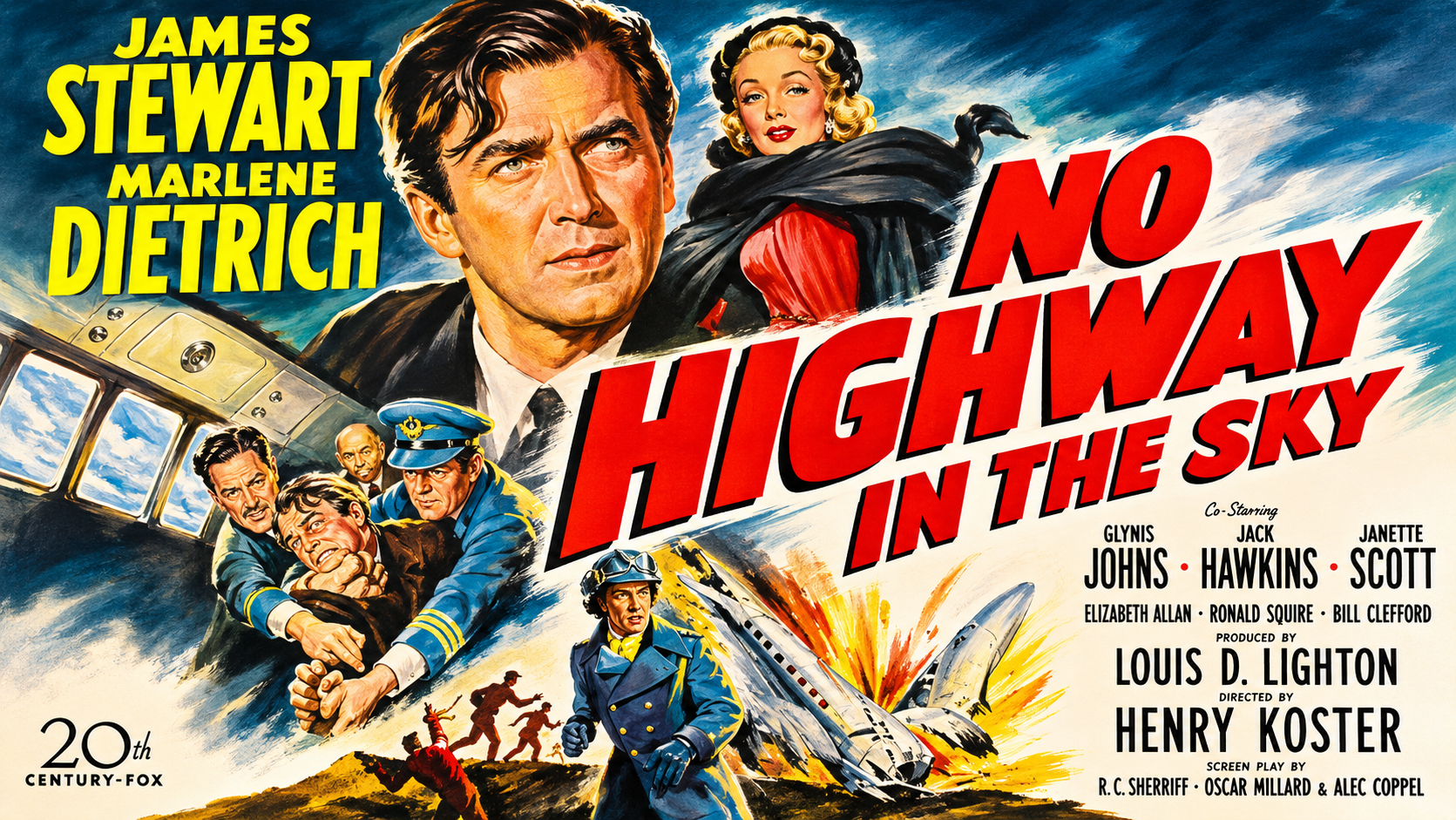
Theodore Honey, a brilliant but absent-minded aviation researcher, believes a new airliner may suffer a catastrophic structural failure after a specific number of flying hours. Travelling to investigate an earlier crash, he discovers that his own aircraft is approaching the danger point. His warning puts scientific conviction against the judgement of those responsible for the flight.
Watch the film
Cast


Also featuring Jill Clifford as Peggy Miller, Niall MacGinnis as Captain Samuelson, Kenneth More as co-pilot Dobson and Wilfrid Hyde-White as Fisher.
Crew
- Director — Henry Koster
- Producer — Louis D. Lighton
- Screenplay — R. C. Sherriff, Oscar Millard and Alec Coppel
- Based on No Highway by Nevil Shute
- Director of photography — Georges Périnal
- Film editor — Manuel del Campo
- Art director — C. P. Norman
- Wardrobe supervisor — Margaret Furse
- Sound recording — Buster Ambler
- Production and distribution — Twentieth Century-Fox
Production history
Adapted from Nevil Shute’s 1948 novel No Highway, the film was one of Twentieth Century-Fox’s British productions. Henry Koster directed James Stewart again after Harvey, with a supporting cast that included Glynis Johns and Jack Hawkins. Denham Studios provided the production base, and Blackbushe Airport supplied location footage.
The British release kept the novel’s title, No Highway, while American audiences saw No Highway in the Sky. Production took place in 1950; contemporary reports recorded Stewart’s emergency appendectomy in London during filming. Stewart and Marlene Dietrich later returned to their roles for a Lux Radio Theatre broadcast on 28 April 1952.
The story gives scientific research an unusually immediate dramatic purpose: a calculation about metal fatigue becomes a question of passenger safety. Shute’s aviation background informed the source novel, while the fictional Reindeer aircraft allowed the film to explore the tension between a warning, its evidence and the practical consequences of acting on it.
More films to enjoy
Cone of Silence (1960) — another aviation drama about safety, evidence and professional judgement.
Channel Crossing (1933) — more suspense during a passenger journey.
Lobby cards and international publicity


Explore more Drama, Thrillers & Suspense and British Cinema.
Credit and production sources: AFI Catalog and Turner Classic Movies.
Follow The Little Picture House for more classic cinema.